Quick Summary
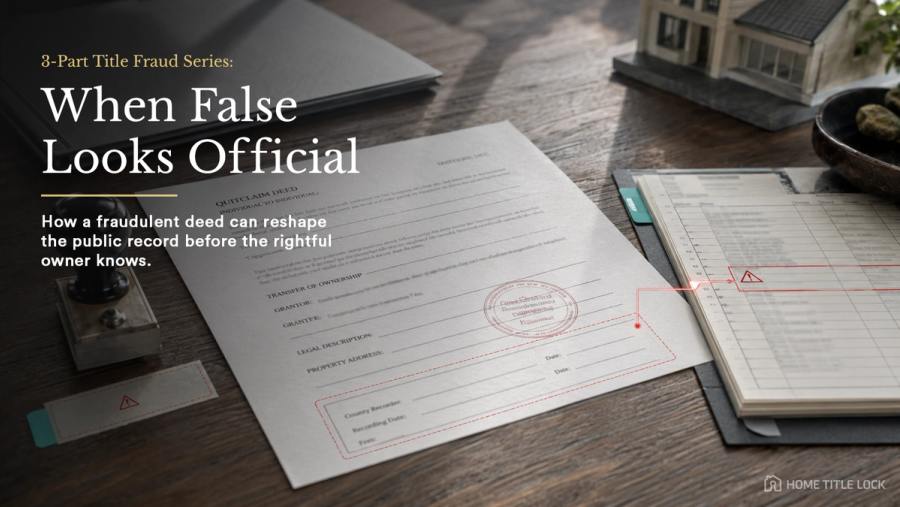
Part 2 of 3. A fraudulent deed becomes more dangerous when it moves from a piece of false paperwork into the public land records.
As explained in How Title Fraud Happens?, a criminal may use impersonation, forgery, or deception to create the appearance that a property owner approved a transfer. Recording is the point when that false claim becomes visible within the official system used to document property interests.
This does not automatically make the fraud legal or eliminate the rightful owner’s interest. It can, however, make the property records appear to show that someone else has ownership rights or authority over the property. That false appearance may also put the homeowner’s accumulated equity at risk if the criminal attempts to sell the property or use it to secure a loan.
What Does It Mean When a Deed Is Recorded?
Recording means that a deed or another property document has been accepted by the government office responsible for maintaining local land records.
The exact process varies by jurisdiction. Generally, the document is marked with a recording date and time, assigned an identifying number, indexed so it can be found, and preserved as part of the public record. Recording also gives public notice that the document and the property interest it claims exist. Source
Once indexed, the deed may appear when a title company, lender, attorney, buyer, government office, or other interested party searches the property records.
That visibility is one reason recording matters. The false document is no longer known only to the person who created or submitted it. It has entered a system that other people may consult when evaluating the property’s ownership history.
Why Can a Forged Deed Still Be Recorded?
Many homeowners assume the county recorder confirms that the current owner approved a deed before accepting it.
Recording offices generally perform a more limited review. Their responsibility is often to determine whether a document meets the legal and administrative requirements for recording, such as the required format, signatures, acknowledgments, property information, and fees.
Recording procedures vary by state and county. However, a recorder’s review generally should not be confused with a complete investigation into whether every ownership claim, signature, identification document, or notarization is genuine.
Tillamook County, Oregon, explains that its clerk’s office does not have the legal authority or practical means to determine the validity or authenticity of every document submitted. The county states that a document meeting Oregon’s statutory recording requirements must be recorded and made part of the public record. Source
In other words, a document may appear complete enough to record while still containing a forged signature or an unauthorized ownership claim. Recording the document does not mean the recorder personally verified the transaction or decided who legally owns the property.
What Changes After the Deed Enters the Public Record?
Before recording, the fraudulent deed represents an attempted claim. After recording, the public records may appear to support that claim.
Someone examining the property history may now see a deed that seems to transfer an ownership interest away from the rightful owner. Depending on what happens next, the unfamiliar deed may be followed by other filings or transactions involving the property.
The FBI has warned that criminals who record phony ownership transfers may attempt to sell the property, take out loans against the equity, or rent it to someone else. The agency has also reported cases in which owners did not learn about the activity until a sale had already occurred or was underway. Source
A recorded deed may therefore create questions that extend beyond a single document:
- Who now appears in the ownership history?
- Has another deed, mortgage, or lien been recorded?
- Has someone attempted to borrow against the property’s equity?
- Has the property been offered for sale or rent?
- Are tax bills or official notices being sent somewhere else?
- Has another person or company relied on the false record?
These questions do not prove that every unfamiliar filing is fraudulent. They explain why an ownership change the homeowner does not recognize should not be ignored.
Why Fraud May Not Be Discovered Immediately
A fraudulent deed does not necessarily create an obvious change at the property. The rightful owner may still have the keys, live in the home, pay the mortgage, maintain insurance, and receive ordinary household bills.
Meanwhile, the ownership activity may exist primarily within land records, transaction documents, or communications involving third parties.
The FBI has reported that deed-fraud victims may remain unaware that their property was sold or was being offered for sale until someone else alerts them. In some reported cases, the transaction and recording were completed before the rightful owner discovered what had happened.
This gap between recording and discovery gives the false record time to create additional complications. It may also give the criminal time to attempt a transaction involving the property or its equity before the rightful owner knows there is a problem.
How One Recorded Document Can Lead to Larger Problems
A 2025 case announced by the New York Attorney General illustrates how the problem can expand. Prosecutors alleged that documents were forged to transfer an elderly widow’s home, followed by another transfer and a $552,500 mortgage involving the property. Source
The charges in that case were allegations at the time of the announcement, but the sequence demonstrates the broader risk. Once a false ownership claim appears in the record, it may be used to support later transactions involving lenders, companies, buyers, or other parties.
For a homeowner, the danger is not limited to the house itself. Years of mortgage payments, property appreciation, and accumulated equity may become connected to an unauthorized loan or sale.
The rightful owner may then need to address more than the original deed. There may also be later documents, financial interests, official records, or competing claims that must be investigated.
Why Unfamiliar Title Activity Should Be Investigated
An alert about a new deed, mortgage, lien, or other property document does not automatically mean fraud has occurred. The filing could relate to an authorized transaction, a loan, a clerical issue, a family matter, or another legitimate event.
However, homeowners should determine what an unfamiliar filing represents rather than assuming it is harmless. A document affecting ownership or equity may have consequences beyond the initial record if someone else relies on it.
New York City advises property owners to report suspected deed theft as soon as possible. The city explains that earlier identification may allow agencies and other partners to review the matter and connect the homeowner with available resources sooner. Source
Homeowners who believe a deed or other document may be unauthorized may need to obtain a copy, contact the appropriate recording office, consult a qualified real estate attorney, and report suspected criminal activity to the relevant authorities. The appropriate response will depend on the property’s location and the facts involved.
County Alerts and Home Title Monitoring
Some counties offer notification programs that alert registered users when a document matching their name or property is recorded. These services can provide valuable notice, but their availability, search criteria, geographic coverage, and notification methods vary.
For example, Tillamook County explains that its alert service applies only to documents recorded after registration and requires separate enrollment for each participating county. The service does not prevent a document from being recorded or determine whether it is authentic. Source
Home Title Lock provides 24/7 title monitoring and alerts members when changes are detected. When a member does not recognize the activity, Home Title Lock researches it with the homeowner to help determine what it means. Source
County notification programs and private title monitoring services can differ significantly in their coverage and the assistance they provide. See County Property Alerts vs. Home Title Monitoring for a closer comparison.
Recording Is Where the Next Challenge Begins
A fraudulent deed does not become truthful simply because it was recorded. It does become part of a public system that buyers, lenders, attorneys, and government offices may consult when evaluating the property.
The longer the unfamiliar document remains unchallenged, the greater the possibility that additional records, loans, transactions, or claims may become connected to it. The homeowner may then face questions involving not only ownership, but also the equity built over years of mortgage payments and property appreciation.
Recognizing unfamiliar activity is only the beginning. The next article examines the third and often most difficult stage of the homeowner’s journey.
Continue the Three-Part Title Fraud Series
A fraudulent deed can create problems long after it is recorded. Explore each stage to understand how the crime begins, what the public record may show, and what may be required to repair the damage:
- Part 1 - The Crime: How Does Title Fraud Happen? explains how criminals create the appearance of ownership.
- Part 2 - The Record: What Happens After a Fraudulent Deed Is Recorded? examines what changes when the document enters the public record.
- Part 3 - The Recovery: Why Is Title Fraud So Difficult to Reverse? explains why correcting the damage is often the hardest part.