Quick Summary
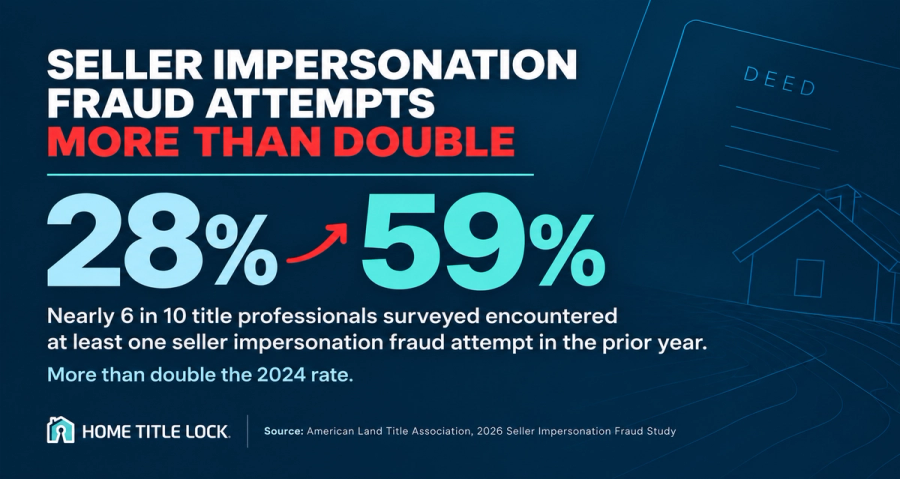
- Seller impersonation fraud attempts are rising sharply. In ALTA’s 2026 survey, 59% of respondents reported at least one attempt during the prior calendar year, compared with 28% in the 2024 survey.
- Vacant land, absentee-owned properties and properties owned free and clear were among the characteristics title professionals most commonly associated with seller impersonation fraud.
- Common red flags included sellers avoiding meetings or calls, requesting mail-away signings or a seller-chosen notary, and cash transactions.
- For homeowners, discovering unfamiliar property-record activity is only the first step. If an unauthorized document has already been recorded, correcting the record can require additional filings, administrative work and legal assistance.
Seller impersonation fraud is becoming a much more common problem for title professionals.
According to the American Land Title Association’s 2026 Seller Impersonation Fraud Study, 59% of respondents reported encountering at least one seller impersonation fraud attempt during the prior calendar year, compared with just 28% in the 2024 survey.
That is more than double the share reported two years earlier.
The study also suggests the problem is becoming more frequent. In the month immediately before the survey, 45% of respondents reported at least one seller impersonation fraud attempt, compared with 19% in the 2024 survey. Nearly one-quarter, 23%, reported three or more attempts during that single month.
What Is Seller Impersonation Fraud?
Seller impersonation fraud generally involves someone pretending to be the legitimate property owner in an effort to sell or transfer property they do not own.
The criminal may use information about the property and its owner to create the appearance of a legitimate transaction while attempting to convince real estate professionals, title companies, buyers or others that they have the authority to sell.
The scheme can be especially difficult to spot when the real owner does not live at the property or when there is no mortgage lender involved in the transaction.
That pattern appears clearly in ALTA’s latest research.
Which Properties Are Showing Up Most Often?
The 2026 study asked title professionals which property types and ownership characteristics they were seeing most commonly in seller impersonation fraud.
Vacant land ranked highest, with 82% of respondents rating it as somewhat common, common or very common. Vacation homes and rental properties also appeared prominently in the findings.
Ownership characteristics matter as well:
- 72% identified absentee owners as common in these cases.
- 68% identified properties owned free and clear.
- 55% identified property belonging to recently deceased individuals.
Those findings do not mean that 82% of all seller impersonation cases involve vacant land, or that every mortgage-free property is at risk. They show which characteristics the title professionals surveyed said they were encountering most frequently.
The Warning Signs Title Professionals Are Watching
ALTA’s study also identified several recurring red flags.
The most frequently cited was a seller who avoids meetings or phone calls, identified by 89% of respondents. Another 88% pointed to sellers requesting a mail-away signing or insisting on a seller-selected notary. Cash transactions were identified by 87%.
These warning signs help explain why seller impersonation fraud can be difficult to detect from a single piece of information.
Title professionals are increasingly relying on multiple layers of verification instead.
Fraud Detection Is Becoming a Layered Process
The study found that 94% of firms use multiple tools they consider helpful for detecting fraud, with an average of 5.3 tools per firm.
Among the leading defenses were:
- Identity verification systems
- Directly contacting the seller
- Multifactor authentication
- Approved notaries
- Knowledge-based authentication
That is an important takeaway for homeowners as well.
There is no single warning sign or single step that eliminates the risk. Awareness, verification and monitoring all play different roles.
What Can Homeowners Do?
Homeowners can periodically review the public property records associated with their home and pay attention to activity they do not recognize.
Where available, county property-record notification programs may also provide another layer of awareness. Home title monitoring can provide additional ongoing awareness of detected changes involving monitored property records.
The ALTA findings are a reminder that criminals may look for properties where the legitimate owner is less likely to be physically present or where fewer parties may be involved in a transaction.
But discovering unfamiliar activity is only the beginning.
An Alert Is Only the Beginning
If an unauthorized deed or other property document has already been recorded, identifying the activity does not automatically correct the public record.
As explained in What Happens After a Fraudulent Deed Is Recorded?, a false document can enter the public property record and create the appearance that an ownership change occurred, even though recording the document does not make the fraud legitimate.
Correcting that record can involve additional documentation, filings, administrative work and, depending on the circumstances, legal assistance. Why Title Fraud Is So Difficult to Reverse explains why recovery can become especially complicated if later deeds, mortgages, liens or other transactions become connected to the property.
That distinction matters as seller impersonation attempts become more widespread.
Monitoring can help homeowners become aware of changes involving their property records. Home Title Lock’s Million Dollar TripleLock® Protection combines 24/7 Monitoring, Urgent Alerts and restoration support if covered title fraud occurs.
The latest ALTA numbers make one point difficult to ignore:
Seller impersonation fraud attempts are no longer something homeowners should assume happens only to someone else.