Quick Summary
Part 1 of 3. Most homeowners think about protecting their property in physical terms. They lock the doors, install cameras, insure the structure, and watch for suspicious activity around the house.
Title fraud is different because it may begin far away from the property. Instead of entering the home, a criminal attempts to manipulate the documents that represent who owns it.
In April 2025, the FBI’s Boston Division warned that reports of quitclaim deed fraud were increasing. The agency described schemes involving forged documents, owner impersonation, and property transfers that the rightful owner never approved. Source
This article is the first part of a three-stage homeowner journey:
- The Crime: How criminals create the appearance of ownership.
- The Record: What changes once a fraudulent document enters the public record.
- The Recovery: Why correcting the damage is often the hardest part.
Homeowners do not need to understand every detail of how the crime is carried out. They should understand the basic idea: a false or unauthorized document can make it appear that someone else has rights to their property.
What Is Title Fraud?
Title fraud involves using deception or unauthorized property documents to create a false claim involving someone else’s home or land. The rightful owner may never have agreed to sell, transfer, mortgage, or give another person authority over the property.
New York City warns that deed theft can involve fraudulent deeds, mortgages, or other documents recorded without the property owner’s knowledge or approval. Source
The goal is often to create the appearance that another person owns the property or has the authority to make decisions involving it. That false appearance may then be used to support an attempted sale, loan, rental, or other transaction.
For a broader introduction to the terminology and warning signs, see What is Title Fraud.
Understanding the Difference Between a Title and a Deed
In everyday conversation, people often use title and deed interchangeably. Legally, however, title refers to the ownership rights connected to a property, while a deed is the written document used to transfer those rights.
That distinction matters because title fraud often involves using a deed or another property document to create the appearance that ownership rights have changed.
The document and the ownership rights are not the same thing. However, when a deed is placed in the public record, people reviewing that record may rely on it when determining who appears to have an interest in the property.
How Criminals Create the Appearance of Ownership
At a general level, title fraud depends on making an unauthorized property transaction look legitimate.
A criminal may pretend to be the property owner, falsely claim to have the owner’s permission, or use documents containing information the owner never provided or approved. The paperwork may then suggest that the property was sold, transferred, or used to secure a loan.
The FBI has warned about criminals impersonating property owners and using forged documents to support phony transfers. The agency has also identified attempted property sales, mortgages, and rental arrangements as ways criminals may try to profit from the fraud. Source
The important point for homeowners is not the precise method used to create the document. It is that false paperwork may resemble an ordinary real estate filing.
That appearance can create confusion about who owns the property and who has the authority to sell, mortgage, rent, or otherwise control it.
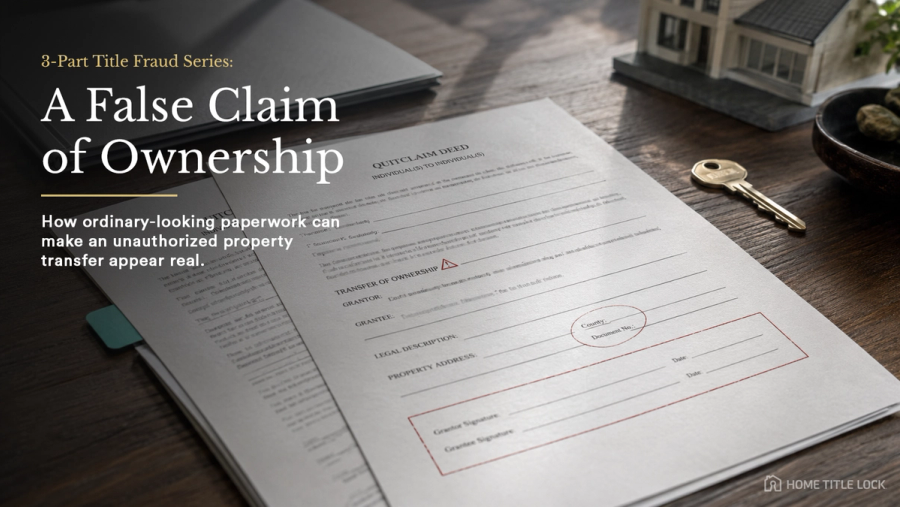
Why Quitclaim Deeds Are Often Mentioned
Quitclaim deeds are frequently discussed in connection with title fraud, but they are not inherently fraudulent.
A quitclaim deed transfers whatever ownership interest the person signing it may have. Unlike certain other types of deeds, it generally does not guarantee that the signer holds a valid title or that the property is free from competing ownership claims. Source
Quitclaim deeds have many lawful uses. They may be used for transfers between family members, spouses, trusts, business entities, or other parties. The use of a quitclaim deed does not, by itself, mean a crime has occurred.
The concern begins when a legitimate document is connected to impersonation, forgery, deception, or a transfer the rightful owner never authorized.
The fraud is not the deed form itself. The fraud is the false claim that the property owner knowingly approved the transfer.
Why Can a Forged Document Still Be Recorded?
Many homeowners assume a recording office confirms that every person, signature, and transaction is genuine before accepting a property document.
Recording offices generally review documents according to the filing rules established in their state or jurisdiction. That review may focus on whether the paperwork contains the information and formatting required for recording. It may not include a complete investigation into the identities of everyone involved or the truth of every statement.
Tillamook County, Oregon, explains that its clerk’s office does not have the legal authority or practical ability to determine whether every submitted document is valid or authentic. Documents that meet the state’s statutory recording requirements must be placed in the public record. Source
Procedures differ by jurisdiction, but the broader distinction is important: accepting a document for recording is not necessarily the same as confirming that the underlying transaction was honest and authorized.
A fraudulent document may therefore enter the public record because it appears to meet the applicable filing requirements. Recording it does not make the fraud lawful, but it may create an ownership claim that must later be investigated and challenged.
Why Homeowners Should Understand the Process
Homeowners do not need to become experts in property law. They should understand a few basic principles:
- Deeds are legitimate tools used to transfer property rights.
- A familiar-looking document can still contain false information.
- Recording a document does not always prove that the transaction was authorized.
- Earlier awareness may give the rightful owner more time to investigate unfamiliar activity.
Once a suspicious document enters the public record, the issue moves into the second stage of the title-fraud journey. The concern is no longer limited to what the criminal attempted to create. The property record may now appear to tell a different story about who owns the home.
Read: What Happens After a Fraudulent Deed Is Recorded? to continue to the second article in the series.
Why Title Monitoring Matters
Most homeowners do not regularly examine their local property records. An unfamiliar filing may therefore go unnoticed until it affects another transaction or creates an unexpected problem.
Title monitoring watches for activity connected to a property and alerts the homeowner when a change is detected. An alert does not automatically establish that fraud occurred. It gives the homeowner an opportunity to determine whether the activity is familiar and authorized.
Home Title Lock provides 24/7 title monitoring and urgent alerts when changes are detected. Its Million Dollar TripleLock® Protection also includes assistance restoring a covered title after a qualifying fraudulent title event, with Home Title Lock spending up to $1 million toward the restoration process. Source
Owner’s title insurance and title monitoring serve different purposes. Before closing, a title search looks for existing ownership disputes, liens, and recording problems. An owner’s title insurance policy generally covers certain title defects that existed before or when the policy was issued, even when the problem is discovered later. It typically does not monitor new public-record activity or transfer automatically to a future buyer. Some policies and endorsements may provide different coverage, so homeowners should review their individual policy terms.
The Crime Is Only the Beginning
Title fraud begins by creating an appearance: the appearance that the rightful owner approved a transfer, that another person has authority over the property, or that an unfamiliar transaction is legitimate.
The paperwork does not have to tell the truth to create confusion. Once it enters the property records, other people may encounter and rely on it before the real owner recognizes the problem.
Understanding how the false appearance is created is the first step. The next article examines what changes when the document becomes part of the public record.
Continue the Three-Part Title Fraud Series
Understanding title fraud begins with the false ownership claim, but the crime is only the first stage. Follow the complete homeowner journey:
- Part 1 - The Crime: How Does Title Fraud Happen? explains how criminals create the appearance of ownership.
- Part 2 - The Record: What Happens After a Fraudulent Deed Is Recorded? examines what changes when the document enters the public record.
- Part 3 - The Recovery: Why Is Title Fraud So Difficult to Reverse? explains why correcting the damage is often the hardest part.