Quick Summary
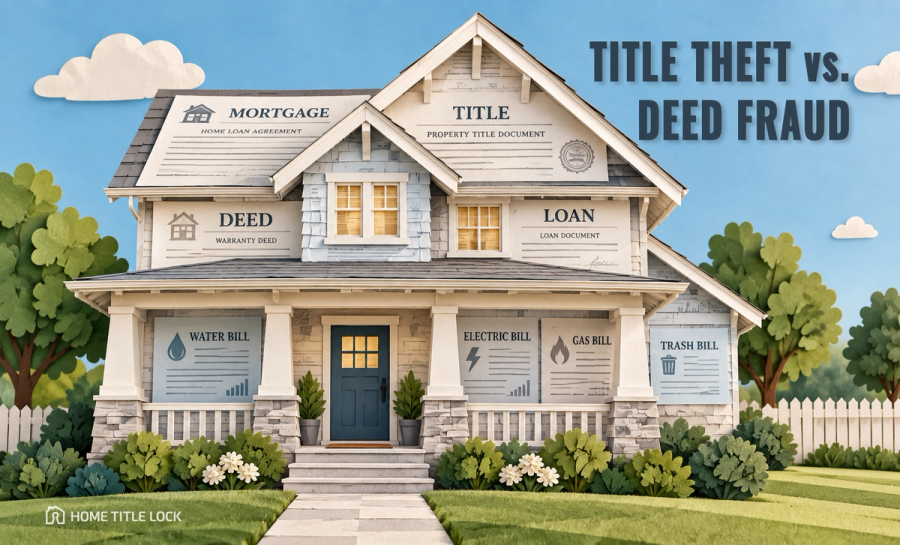
- Home title theft is the broader consumer-facing term, while deed fraud is one of the main ways it can happen. Deed fraud can involve false or forged property documents that make it appear in the public record that ownership has changed.
- Vacant land, unoccupied homes, rental properties and properties without mortgages or other liens may attract fraud attempts, including schemes in which a criminal impersonates the true owner.
- Warning signs can include unfamiliar deeds, mortgages or liens, missing tax or utility bills, county recording notices, or a property being listed for sale without the owner’s knowledge.
- Title insurance, county fraud alerts, title monitoring and Home Title Lock serve different purposes, from insurance coverage and notification to ongoing monitoring, Urgent Alerts and restoration support.
Home title theft and deed fraud are closely related, and the terms are often used interchangeably. There is, however, a simple distinction worth understanding.
Home title theft is the broader consumer-facing term. It describes schemes in which someone attempts to gain control of, sell, borrow against or otherwise profit from property they do not own.
Deed fraud is one of the main ways home title theft can happen. It usually involves a forged, altered or fraudulently obtained deed being used to make it appear that ownership of a property has changed.
Once a fraudulent deed is recorded, the public record can make it appear that the rightful homeowner transferred the property to someone else. The false deed can cloud the title, interfere with a sale or refinance, and force the homeowner into a potentially costly and lengthy process to clear the record and restore the title.
The FBI has warned property owners about schemes involving forged deeds, identity theft and criminals impersonating legitimate property owners.
How Does Home Title Theft Happen?
A title theft or deed fraud attempt can begin with information that is already publicly available.
A criminal may identify a property through public records, research the owner and then attempt to impersonate that person. Fake identification, forged signatures, fraudulent notarizations or other false documents may be used to make the transaction appear legitimate.
If a fraudulent deed is accepted and recorded, the property records can appear to show that ownership has changed. That false record may then be used in an attempt to sell the property, borrow against it or carry out another transaction.
The FBI has warned about criminals searching public records for vacant parcels and properties without a mortgage or other lien. In one scenario described by the FBI, the criminal poses as the owner, contacts a real estate professional, attempts to sell the property quickly and tries to collect the proceeds before the rightful owner discovers the fraudulent transaction.
Vacant land, unoccupied homes and rental or investment properties can be attractive targets because the true owner may not be physically present or regularly checking the property's public records.
What Are the Warning Signs of Home Title Theft?
A fraudulent deed can enter the public record without the rightful homeowner knowing about it. In some cases, the first indication comes later, when the homeowner receives an unexpected notice, attempts to sell or refinance the property, or discovers unfamiliar activity in the property records.
Warning signs can include:
- A deed, mortgage, lien or other recording you do not recognize
- Property tax or utility bills that unexpectedly stop arriving
- Unusual utility activity at a vacant property
- Your property appearing for sale when you did not list it
- A notice from a county recorder about an unfamiliar filing
- Unexpected mortgage or other real-estate activity tied to the property
The FBI recommends that property owners regularly check their property records and enroll in county recording or property fraud monitoring & alert programs where they are available.
What Types of Home Title Protection Are Available?
There are several ways homeowners can address title-related risks, but they do not all provide the same thing.
Owner's title insurance is generally purchased when a home is bought. It is designed primarily to cover certain title defects, liens, ownership disputes, fraud, forgery or other covered problems that already existed at or before the time of purchase, even if those problems are not discovered until later. The premium is typically paid once at closing.
Traditional owner's title insurance is primarily designed to address covered title problems that existed before or at the time of purchase. It is not an ongoing monitoring service and does not continuously watch public property records for new filings or changes after the home is purchased.
County property fraud alerts are offered by many county recorder or clerk offices, often at no cost. When certain documents associated with a homeowner's name or property are recorded, the county may send an email, text or other notification.
These programs can be useful, but an alert typically tells you that a document was recorded. It does not necessarily determine whether the filing is fraudulent, and county programs generally do not provide legal or title-restoration assistance. Availability and the records monitored also vary by county.
Title monitoring services watch public property records for new filings or changes connected to a home. Instead of requiring homeowners to repeatedly search public records themselves, monitoring can alert them when activity is detected.
Homeowners comparing monitoring services should look beyond the alert itself. Important questions include what records are monitored, how frequently they are checked and what assistance is available if an unfamiliar change is found.
Home Title Lock combines 24/7 title monitoring, Urgent Alerts and restoration support through its Million Dollar TripleLock® Protection.
When changes to a monitored title are detected, the homeowner is alerted. If title fraud occurs, Home Title Lock provides access to U.S.-based title restoration experts and will spend up to $1 million to help restore a covered title to its status before the fraudulent title event, subject to the terms and conditions of the TripleLock® Protection Warranty.
Home Title Lock offers monthly, annual and multi-year plans, with monthly service starting at $19.95.
These options are not necessarily substitutes for one another. A homeowner may already have title insurance, enroll in a free county alert program and still choose additional monitoring.
For homeowners, the questions are simple:
- Who is watching the public records tied to my home?
- How will I know if something changes?
- And if something does go wrong, who will help me fix it?