Quick Summary
- In June 2026, the FBI warned that criminals are impersonating vacant-property owners and attempting to sell land without their knowledge or permission.
- Fraudsters may combine public records with fake identification, new email accounts, internet-based phone numbers, forged documents, and AI-assisted impersonation.
- Vacant land, mortgage-free homes, second homes, inherited property, rentals, and out-of-state properties may receive less day-to-day attention.
- County recording alerts provide a useful notice, but they do not investigate unfamiliar activity or help restore a damaged title.
- Home Title Lock monitors property records, alerts customers to changes, researches unfamiliar activity, and provides restoration support when title fraud is confirmed, subject to the TripleLock® Protection Warranty.
Your front door can be locked. Your alarm can be armed. Your property can still be targeted without anyone stepping onto the driveway.
The attack may begin with public records, a fake identity, and someone pretending to be you. By the time the owner discovers it, the property may already be listed, sold, or all the equity drained.
The FBI Just Described the Scam Step by Step
On June 16, 2026, the FBI warned about criminals posing as vacant-property owners and attempting to sell parcels without the owners’ knowledge or consent.
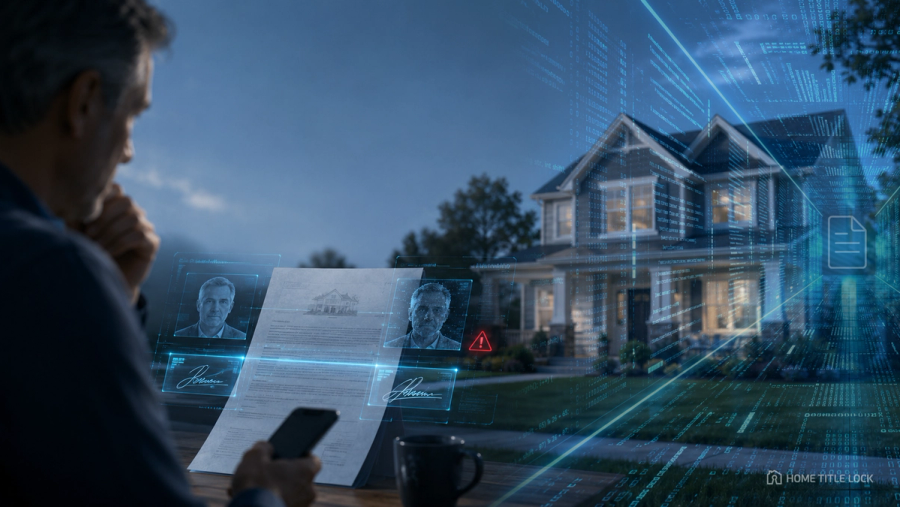
Criminals may obtain an owner’s information through public government websites, data brokers, stolen accounts, phishing schemes, hackers, or dark-web sources. They then create fake identification, email accounts, and internet-based phone numbers to appear legitimate.
The impersonator contacts a real estate agent and title company, prepares contracts, and tries to market the property. The FBI described a fraudulent deed was used to make the impersonation more credible. Source: https://www.ic3.gov/PSA/2026/PSA260616
AI Can Make the Impersonation Harder to Spot
Artificial intelligence is evolving at a pace that can be difficult to comprehend. Even during the first six months of 2026, tools capable of producing convincing emails, altered images, cloned voices, fake identification, and realistic video became easier to access and use. What may have required advanced technical skills at the beginning of the year can now be accomplished faster and with fewer barriers.
For property owners, that means impersonation attempts may become more polished, more believable, and harder to recognize before a transaction or filing moves forward.
The FBI warning does not state that every parcel-owner impersonation case uses artificial intelligence. However, these schemes depend on convincing communication, fabricated identities, altered documents, and remote transactions, all areas where AI can strengthen a criminal’s presentation.
The National Association of REALTORS® reported in a 2026 consumer guide that deepfake scams increased 40% year over year, citing Entrust’s Identity Fraud Report. Source: https://www.nar.realtor/the-facts/consumer-guide-spotting-deepfake-scams-in-real-estate
The FBI’s 2025 Internet Crime Report recorded 115 real estate complaints that included an AI reference, with approximately $2.7 million in reported losses. These figures cover the FBI’s broader real estate crime category, not deed fraud alone, but they confirm that AI is already appearing in real estate-related crime reports. Source: https://www.ic3.gov/AnnualReport/Reports/2025_IC3Report.pdf
Why Longtime Property Owners Should Pay Attention
Longtime homeowners often have something criminals want: equity. Paid-off homes, vacant parcels, inherited property, rentals, second homes, and out-of-state property may also receive less frequent attention than a primary residence.
Among people age 60 and older, real estate complaints reported to the FBI increased from 1,765 in 2024 to 2,473 in 2025. Reported losses rose from approximately $76.3 million to $123.7 million. These totals include multiple forms of real estate crime, but the increase is difficult to ignore. Source: https://www.ic3.gov/AnnualReport/Reports/2025_IC3Report.pdf
Title fraud can involve forged deeds, unauthorized transfers, fraudulent liens, or loans connected to a property. Learn how it works: https://www.hometitlelock.com/what-is-title-fraud
The First Warning May Come After a Record Changes
A homeowner may not realize something is wrong until an unfamiliar property listing appears, tax or utility notices change, loan documents arrive, or a deed, lien, or other document is found in the public record.
The FBI recommends checking whether your local recorder, register of deeds, appraisal district, or clerk offers recording notifications. These programs can help, but an alert does not explain what a filing means, determine whether it was authorized, or provide the support needed to correct the record. Source: https://www.ic3.gov/PSA/2026/PSA260616
County alerts can be an important layer of awareness, but notification is not restoration support. Learn more: https://www.hometitlelock.com/articles/why-county-alerts-dont-stop-title-fraud
How Home Title Lock Helps
Home Title Lock’s Million Dollar TripleLock® Protection is designed around three stages:
- 24/7 Monitoring: Property records are monitored around the clock for changes.
- Alert and research: Customers are notified when a change is detected. If the activity is unfamiliar, Home Title Lock researches it with the customer to help determine what happened.
- Restoration: If title fraud is confirmed, U.S.-based Title Restoration Experts help manage the recovery process, with up to $1 million in support coverage for legal fees, filing costs, and administrative expenses.
Learn how Million Dollar TripleLock® Protection works: https://www.hometitlelock.com/articles/million-dollar-triplelock-title-fraud-protection
No service can physically prevent someone from attempting to submit a forged document. The value of monitoring is finding changes early, understanding unfamiliar activity, and having a defined path forward if fraud is confirmed.
Your House May Look Fine While the Paper Trail Changes
AI deed scams are not only about new technology. They are about criminals using public information, impersonation, forged documents, and speed to target property owners who may not realize this type of fraud exists.
That is what makes these schemes so unsettling. Your home can look exactly the same. You may still have the keys, pay the taxes, and receive the mortgage statement. Yet an unfamiliar deed, loan, or ownership-related document could appear in the public record without creating an obvious warning at your front door.
Checking your county records and enrolling in a free county recording notification program, where available, are smart first steps. A county alert may help you learn that a document connected to your property has been recorded. But the alert itself may leave you with a more urgent question: What happens next?
A notification may not tell you whether the activity is legitimate, explain what the document means, research the people involved, or help correct the property record if fraud is confirmed. The homeowner may still need to determine what changed, whether the filing was authorized, and which agencies or professionals to contact.
That is the gap Home Title Lock is designed to help address. Home Title Lock monitors property records and alerts customers when changes are detected. If a customer does not recognize the activity, the company researches it with them to help determine what happened. If title fraud is confirmed, U.S.-based Title Restoration Experts can help guide the restoration process, subject to the TripleLock® Protection Warranty.
Awareness is the first layer of protection. An alert can provide an early warning. But knowing what to do after the alert is what matters most.